Our Core, Plus, and Prime camera families give OEMs scalable hardware options tailored to different performance and integration needs. Paired with CDAT™, each tier delivers consistent perception in low visibility conditions and supports regulatory readiness for next generation safety systems.
Ideal for OEM teams who want to integrate infrared imaging into their own perception stack, simulation tools, or sensor fusion frameworks. CAM provides high quality thermal image without bundled algorithms, giving engineering groups full flexibility in how the sensor is applied.

| Sensor Format | VGA |
| Resolution | 640 (H) x 480 (V) |
| Field of View | CORE or Wider FOV Available |
| Camera Size |
28mm front diameter x 39mm depth (Add 12mm depth for connector header) |
| Mass | < 75g |
Our system is developed to meet the requirements of key global safety standards. View Compliance Information
Infrared sensing reaches far beyond consumer automotive. It delivers dependable visibility in environments where traditional cameras, headlights, and human sight begin to fail.
Across industries, infrared provides clear, real time awareness in conditions where safety hinges on seeing what visible light systems cannot.
In commercial trucking, infrared supports earlier long-range detection at night, helping reduce collisions with pedestrians, wildlife, and roadside obstacles.
Rail and transit systems benefit from thermal detection along tracks and platforms, improving awareness during fog, nighttime operations, and low-contrast conditions where visible cameras struggle.
Mining and construction fleets rely on infrared for operator awareness in dust, darkness, and smoke-filled environments.
Aerial platforms, including drones, use thermal signatures for inspection, mapping, and search-and-rescue.
Emergency responders depend on infrared to locate people through darkness, smoke, and foliage.
Busses and shuttle fleets, infrared improves awareness at stops, crosswalks, pick-up zones, and other high-traffic areas where passengers move unpredictably around large vehicles.
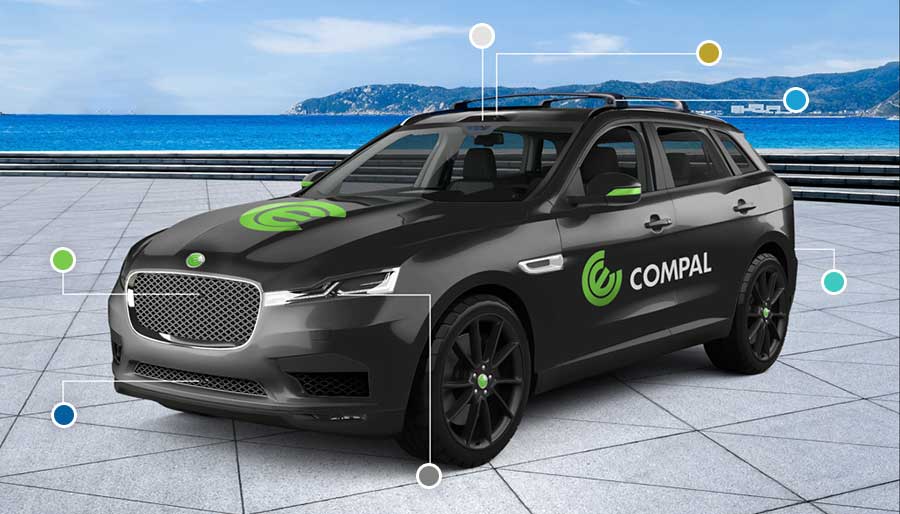
Compal’s infrared cameras can be mounted in the grille, bumper, headlamps, behind the windshield, on the roof, or within the rear fascia. Their compact footprint fits common OEM packaging constraints and supports front, side, and rear coverage for a wide range of safety features. The cameras integrate seamlessly alongside radar, LiDAR, and RGB sensors, strengthening perception without replacing the existing sensor suite.



quick links