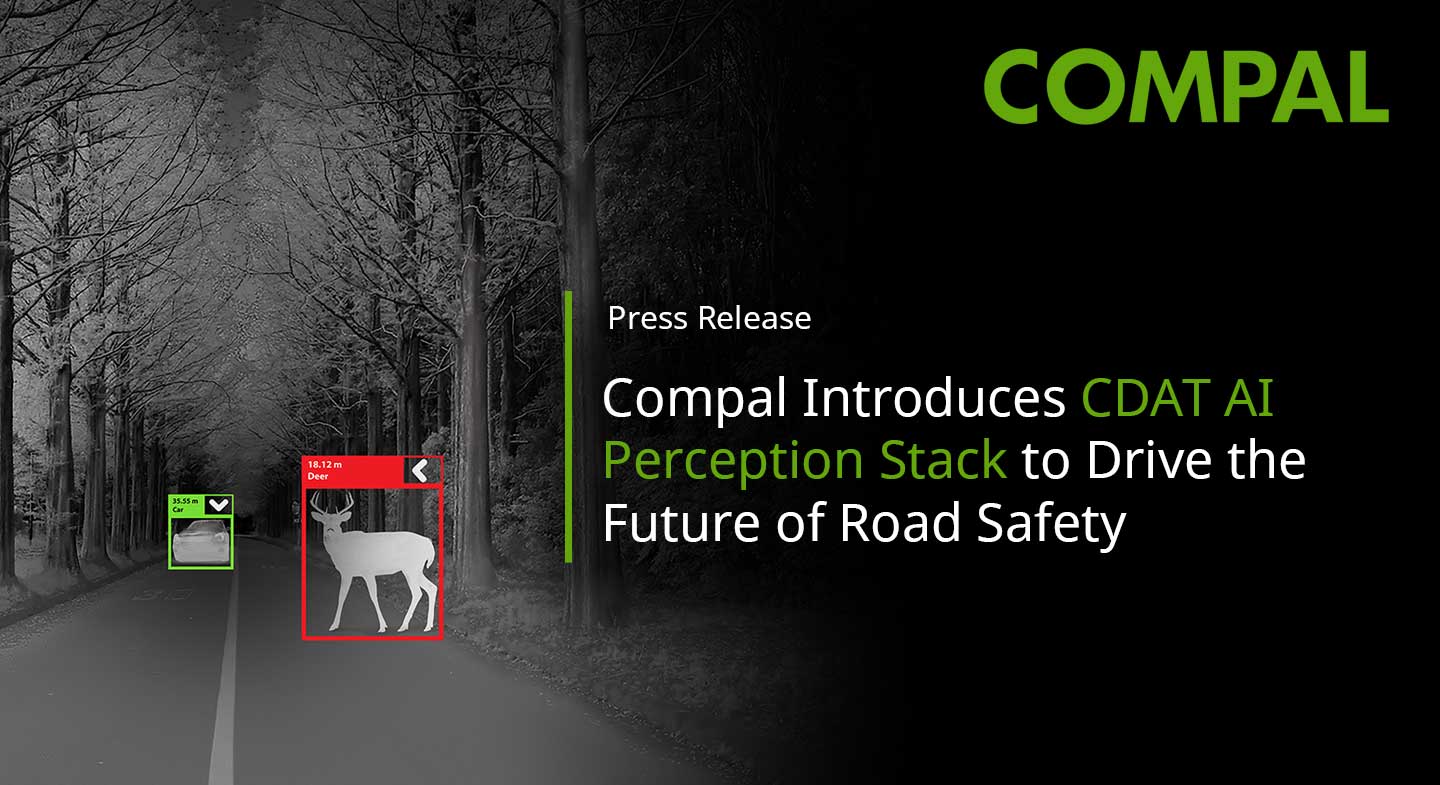
Taiwanese tech giant Compal Electronics unveiled its next-generation Infrared Technology Systems (ITS) for automotive sensors. This system integrates the CDAT perception computing platform with AI technology, enabling ADAS (Advanced Driver Assistance Systems) to enhance pedestrian recognition in low-visibility environments. It meets the performance requirements of specific vehicle regulations FMVSS 127 and UN R152 for automatic emergency braking of pedestrians. Furthermore, it can be paired with Compal’s next-generation automotive radar solutions to achieve high-precision detection capabilities at long, medium, and short ranges.

Compal Electronics, a major Taiwanese technology company, has unveiled its new generation of Infrared Technology Systems (ITS) for automotive applications. The CDAT perception computing platform, which integrates AI technology, can help ADAS (Advanced Driver Assistance Systems) enhance pedestrian recognition in low-visibility environments.
According to Compal’s information, this new generation of infrared sensing solutions is mainly designed to improve vehicle performance in nighttime and low-visibility conditions. Its infrared camera offers multiple viewing angles, including 32 degrees, 45 degrees, and 60 degrees, and is compatible with Level 2 to Level 4 ADAS system specifications. The sensor also integrates the AI-driven CDAT perception computing platform, enabling accurate detection of pedestrians, bicycles, animals, vehicles, and motorcycles even in high-contrast, glare, fog, rain, snow, and smoke environments.
Compal Electronics’ subsidiary, SmartEasy Technology, also offers automotive radar sensors that can be used in conjunction with this infrared sensor. Through the dual technology of infrared and radar sensing, the accuracy and reliability of ADAS and AEB systems are improved.
Compal Electronics’ subsidiary, SmartEasy Technology, also offers an automotive radar sensor that can be used in conjunction with this infrared sensor. Through the dual technology of infrared and radar sensing, it enhances the accuracy and reliability of the AEB system. This radar module also supports ADAS systems, parking assistance systems, next-generation autonomous driving, and Advanced Corner Radar functions such as BSD, LCA, and RCTA. It complies with UN R151/R159 specifications and can be expanded with 4G/5G vehicle-to-everything (V2X) T-Boxes and automotive-grade Wi-Fi modules.
In short, infrared sensors provide the sensing information needed for short-range, AEB (Autonomous Emergency Braking) systems, while radar provides precise object identification at longer and medium ranges, as well as sensing from different locations such as the sides and rear. According to Compal, their sensing solutions can be installed in various locations on the vehicle, including the grille, headlights, windshield, roof rack, and bumpers.
Richard Seoane, General Manager of Compal’s ITS Business Unit, said, “Infrared technology can compensate for the shortcomings of traditional sensors. Compal is demonstrating how automotive infrared technology systems and CDAT can enhance the ability to perceive low-visibility environments—and through cooperation with Zhiyi, we are creating a more complete automotive safety detection architecture.”
Article Reference: https://news.u-car.com.tw/news/article/86689


quick links